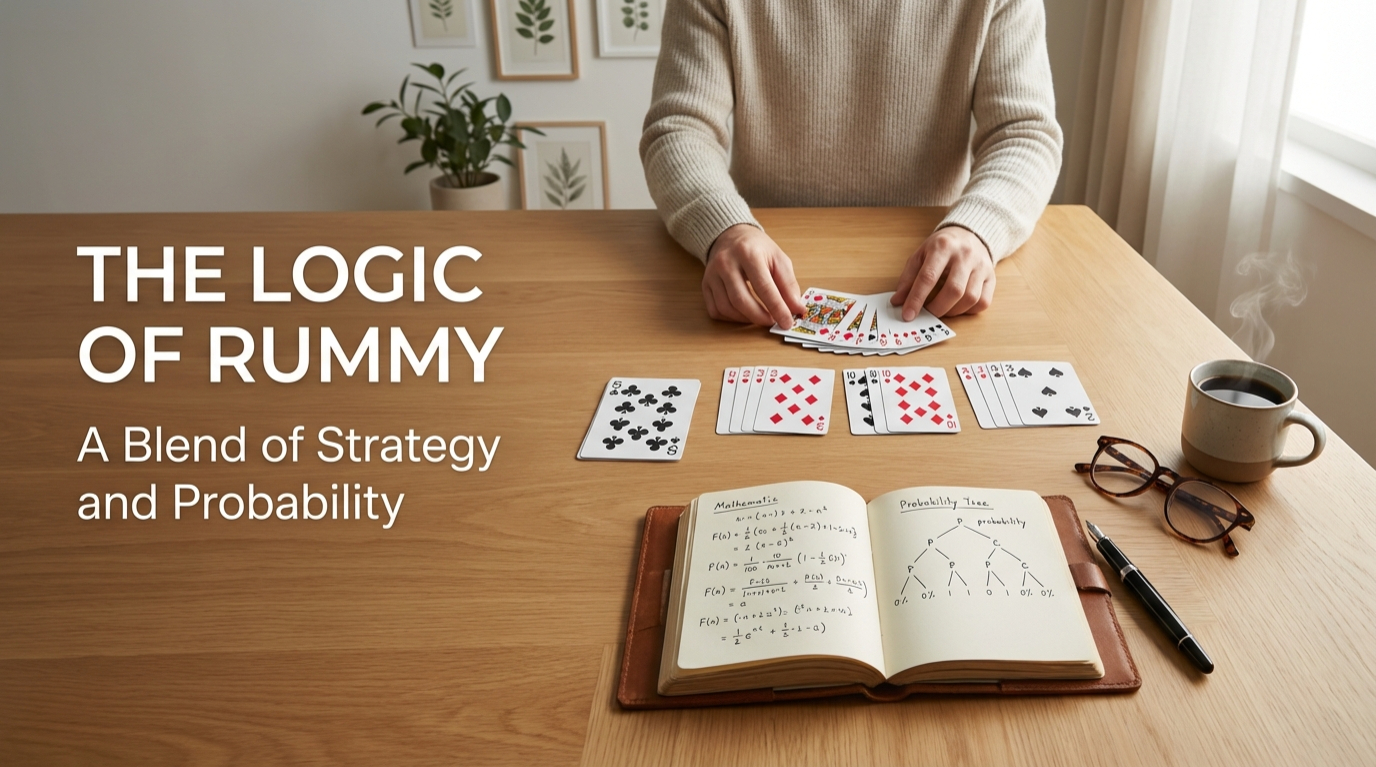
In the competitive world of digital card games, the gap between a casual player and a professional is defined by a single factor: the commitment to improving card game skills. While many beginners rely on the “luck of the draw,” seasoned veterans understand that rummy is a game of deep strategy, calculated risks, and psychological endurance.
Whether you are playing for fun or looking to dominate the tables, improving card game skills requires a systematic approach. This 2000-word masterclass will deconstruct the layers of high-level play, from basic sequencing to advanced mathematical probability in rummy.
1. The Foundation: Understanding the Skill vs Chance Distinction
To begin improving card game skills, one must first accept that rummy is a game of intellect. The Supreme Court of India has long upheld the skill vs chance distinction, classifying rummy as a “game of mere skill.”
This means that over a long series of games, a player with better advanced rummy strategy will consistently outperform someone relying on luck. Skill in rummy involves:
- Memory: Keeping track of every card picked and discarded.
- Calculation: Knowing the odds of drawing a specific card.
- Adaptability: Changing your hand structure based on the opponent’s moves.
2. Master the Art of Discard Pile Analysis
One of the most effective card game observation techniques is the meticulous analysis of the discard pile. Most amateurs focus only on their own 13 cards, but a pro looks at the entire table.
Tracking Opponent Behavior
By watching what your opponents discard, you can deduce what they don’t need. More importantly, by watching what they pick from the open deck, you know exactly what they do need.
- Defensive Discarding: If your opponent picks a 7 of Spades, you should avoid discarding a 6 or 8 of Spades.
- Baiting the Table: This is a high-level advanced rummy strategy where you discard a card to “bait” your opponent into throwing a card that completes your sequence.
3. The Mathematical Element: Probability and Odds
You cannot succeed in improving card game skills without embracing numbers. Rummy is, at its heart, a mathematical puzzle.
Calculating the Outs
“Outs” are the cards remaining in the deck that can complete your sets or sequences. Mathematical probability in rummy dictates that you should always pivot your hand toward the structure that has the highest number of “outs.”
The Joker Management
The Joker is the most powerful card, but using it requires skill. Professionals use Jokers to complete “impure” sequences early, freeing up their natural cards to form the mandatory “pure” sequence. Understanding the statistical frequency of Jokers in a two-deck game is crucial for improving card game skills.
4. Psychological Conditioning: Mental Games for Adults
Rummy is often categorized among the top mental games for adults because it tests emotional resilience.
The “Drop” Strategy
One of the hardest skills to learn is when not to play. A skilled player knows that an “Early Drop” is not a sign of weakness but a calculated move to minimize point loss. This discipline is a vital part of improving card game skills.
Patience and Focus
Digital tables move fast. Maintaining focus over 50 or 100 hands is what separates the winners from the losers. Developing this mental stamina is just as important as learning the rules themselves.
5. Fair Play and the Competitive Ecosystem
When you are focused on improving card game skills, you need to ensure you are playing in a secure online gaming environment. Fairness is the baseline that allows skill to manifest.
Platforms like OKRummy are designed for skilled players. By ensuring online rummy fair gameplay through RNG certification, these platforms guarantee that your hard-earned strategies aren’t undermined by technical bias. In a fair ecosystem, your growth in improving card game skills directly translates into better results.
6. Financial Discipline: Bankroll Management
No guide on improving card game skills is complete without discussing bankroll management in gaming.
- Set a Budget: Never play with money meant for essentials.
- Limit Your Stakes: Play at tables where your total bankroll can cover at least 20 to 50 buy-ins.
- Avoid Chasing Losses: Emotional betting is the enemy of strategy.
7. Step-by-Step Roadmap to Mastery
If you are serious about improving card game skills in 2026, follow this roadmap:
- Study the Rules: Master the difference between pure and impure sequences.
- Practice for Free: Use practice tables to test card game observation techniques without risk.
- Record Your Games: Review your wins and losses to find patterns in your mistakes.
- Join Communities: Engage with other players to discuss advanced rummy strategy.
Conclusion: The Journey of Continuous Improvement
Improving card game skills is a marathon, not a sprint. The more you treat rummy as a mathematical and psychological challenge, the more rewarding the experience becomes. By combining mathematical probability in rummy with disciplined bankroll management, you transform from a casual player into a true strategist.
How long does it take to master rummy?
The basics take minutes, but improving card game skills to a professional level can take months of consistent practice and study.
Is memory the most important skill in rummy?
Memory is vital, but adaptability—the ability to change your strategy mid-game—is what defines the elite.
Why is rummy better than other card games?
Rummy offers a unique blend of organizational logic and probability, making it one of the most balanced mental games for adults.